


Ebook Free Love at Goon Park: Harry Harlow and the Science of Affection
Do you really feel much better after completing a book to review? What's your feeling when obtaining a new book once again? Are you challenged to review as well as complete t? Good visitor! This is the moment to conquer your goo routine of analysis. We reveal a better book once more to delight in. Visiting this site will be additionally packed with determination to read? It will certainly not make you feel bored since we have different types and also kinds of guides.
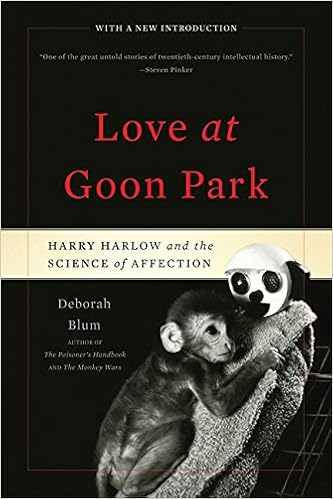
Love at Goon Park: Harry Harlow and the Science of Affection

Ebook Free Love at Goon Park: Harry Harlow and the Science of Affection
Success is an option. It's just what lots of people say and also recommend making others be succeeding. When someone chooses to be success, they will certainly try huge effort to recognize. Lots of means are planned as well as undergone. Absolutely nothing restricted, however there is something that may b forgotten. Seeking for understanding as well as experience need to remain in the strategy and process. When you always extra these 2, you could complete your plans.
Yet, after locating this website you may not be doubt and really feel tough any more. It appears that this internet site uses the most effective collections of the book to read. When you want such subject, Love At Goon Park: Harry Harlow And The Science Of Affection can be a selection. Wow, enjoy this book a lot. Do you feel the exact same? Well, really, it's not mosting likely to be hard when expecting this publication as the analysis material. After discovering the excellent web site as this on the internet collection, we will be so very easy in finding several styles of publications.
To make certain regarding the book that should be read, we will reveal you just how this publication is really better. You can see just how the title exists. It's so fascinating. You can additionally see exactly how the cover layout is show; this is just what makes you feel interested to look extra. You can likewise locate the web content of Love At Goon Park: Harry Harlow And The Science Of Affection in an excellent expiation, this is just what makes you, plus to feel so completely satisfied reading this publication.
Nevertheless, checking out the book Love At Goon Park: Harry Harlow And The Science Of Affection in this website will lead you not to bring the printed publication anywhere you go. Merely keep guide in MMC or computer system disk as well as they are available to check out at any time. The thriving system by reading this soft data of the Love At Goon Park: Harry Harlow And The Science Of Affection can be leaded into something new behavior. So currently, this is time to show if reading can boost your life or not. Make Love At Goon Park: Harry Harlow And The Science Of Affection it definitely work as well as get all benefits.
About the Author
Deborah Blum is the New York Times bestselling author of The Poisoner's Handbook. She also won a Pulitzer Prize in 1992. Her second book, Sex on the Brain, was a New York Times Notable Book for 1997. She lives with her family in Madison, Wisconsin.
Read more
Product details
Paperback: 368 pages
Publisher: Basic Books; 2 edition (July 5, 2011)
Language: English
ISBN-10: 046502601X
ISBN-13: 978-0465026012
Product Dimensions:
5.5 x 0.8 x 8.3 inches
Shipping Weight: 1.2 pounds (View shipping rates and policies)
Average Customer Review:
4.4 out of 5 stars
48 customer reviews
Amazon Best Sellers Rank:
#80,544 in Books (See Top 100 in Books)
When Harry Harlow started exploring the science of affection it was in the face of disregard and opposition in the world of medicine and psychology. But he was able to show that affection is vital to the proper development of the newly born, as too is the measured rejection of the newly born's parents when the time is right. Consequently we now encourage the bonding of parents and children through physical handling. (Perhaps more affectionate and supportive friendships outside the family have developed as a result also.)These were great insights for society and yet Harlow did face opposition. Just when he was saying the role of the mother (and father - but he was less vocal about that) was vital to the upbringing of the baby, the womens liberation movement was trying to get women more freedom - more equality on the basis of being the same as men. How could this new emphasis on the importance of the role of parents (principally women as men were traditionally the 'bread winners') be tolerated? To me, however, there is a mistake in this. We should not be treated equally because we are the same - but for the very opposite reason - because we are all unique. If we are to get the best from each unique individual then each individual must have equal rights and opportunity. Unfortunately Harlow's approach to opposition was often rude and confronting.After his death Harlow's research faced another challenge - this time from the animal liberation activists. Harlow had done his experiments on monkeys principally, and these experiments necessarily had damaging (and surprising) results for the animals experimented on. Harlow did care for the animals and provided for them as well as he could in difficult circumstances - for example, he always tried to 'restore' emotionally damaged animals. Although we may now regret the methods he and his students used, and certainly not want to repeat them for the sake of student exercises, we should not lose sight of the vital information that was uncovered.Deborah Blum's book is engaging and revealing - especially concerning the history of human behaviour with regard to affection and love. It is surprising how recent (1950s) some attitudes were that are now totally overthrown, at least in part because of Harlow's work.But does psychology have more lessons to learn from Harlow? It is my belief that this is so. I recently had a workplace experience where I was confronted by a workplace bully. But immediately I knew this bully was not picking on me - this was just characteristic behaviour that was applied to everyone they worked with. All the stories and rumours I had heard - and continued to hear with more clarity - suddenly had greater presence for me. To overcome my distress at this situation I used the free staff counselling service offered by my employer. Perhaps in doing that I was already demonstrating my capacity to manage, to cope. What, however, of my colleagues who I now had insight to the terrible behaviour of the bully for them? Harlow would not have been surprised that I had bonded with these people - to some more closely than others. But the psychologist/counsellor understood nothing of this - as long as I was dealt with (the immediate client) nothing else could be done. But the only thing that could really be done for me was to smash all the bonds I had built with my colleagues so that I was no longer concerned for them. Was that reasonable?And what of psychology offered to one of a married couple privately from the bond that links them. What is the risk that this will actually prise apart the bond that needs to be strengthened or at least maintained? I'm not sure how psychology should handle these matters but it continues to alarm me that the insights of Harlow are still being overlooked in areas where they should not be. Is it the impact of the womens liberation and animal liberation movements that have denigrated the research sufficiently to block its use in other areas?other recommendations:'Workplace Monsters' John Clarke (Random House Australia)'Conditions of Love' John Armstrong'A Crystal Age' W H Hudson
This is an extremely interesting book in terms of underlining how damaging scientific fads can be. The early twentieth century fad of data and cleanliness may well have led to the deaths many children as cleanliness was preferred over attention.Unfortunately, Harry Harlow is less interesting, and provides an abominable contrast to the subject. Harlow ignores both wives and his children in search for - as he wrote in his school's yearbook - 'fame'. He becomes a chain-smoking alcoholic. Bizarrely, Blum emphasises Harlow's visionary understanding of love with, at times, an almost 'here comes superman' manner. She appears incapable of reconciling her argument that Harlow is the scientist of love with the fact that he ignored his wives and all his children!If anything, I read the book as reflecting one man's selfish, desperate desire for achievement and fame. Thanks to his interest in monkeys, he and his students seemed to fall over the answer. Not exactly visionary.A good read though, reflecting the pitfalls of faddish thinking, and also how scientific discoveries (if the fact that a child needs its mother is a discovery) occur. The book also reflects how difficult it can be to refute incorrect arguments.
I was wondering what love was since I have never felt love in my life. This thought first came from a religious perspective which states that without love you have nothing. I don't think that I have any ability to love. I bonded with my father rather than my mother, but this was a very limited relationship because just as I had never seen an example of familial love, neither had my parents. I kept reaching out to my father but with no success.I have a good memory of my early childhood, and this book reinforced what I had already suspected. While I took the blame for all of their disappointments in me, it was they who made me what I was.I lived to get away from my mother. And I had decided by the time that I graduated from high school that I could not put another child through what I had been through. I would have been exactly like her because I had never seen an example of a child being loved.My mother did not want to be a mother. This book explains why I am the way that I am today, anxious and isolated and not being able to socialize.The learning disabilities that I had were monumental, but at least I lived during a time where I was not labeled.I scored poorly on the Stanford Binet test and overheard my mother say to my dad that she guessed that I would never amount to nothing.This book is so important, and if it makes women feel guilty, so be it. How the mother treats the child determines the child's future.I love animals, and the thought of using them for testing makes me sick. But if testing animals will make people understand what they are doing to their children, it is worth it and PETA be damned.
This is a phenomenal book about the necessity of love and exactly what that means scientifically. What is necessary from a mother and how should the child be pushed into the world with the mother's backing ? What are the biochemical effects and what other sources can bring back a poorly mothered child ? What relatives and friends and environment can make a difference ? Watching monkey families in tough circumstances can tell us what we need to know.Harry Harlow's real life is set against the primate family situations in this compelling story of love's basic place in our lives set against the psychology of the day including other giants such as Bowlby. It makes one challenge and examine the relationships in their lives.
Fun to read history of a famous psychologist -- the one that gave us the "hard wire mother" and the "soft towel mother" ---- discovering that lonesome baby monkeys preferred the "soft mother" --(if you can imagine that!). It's interesting !!!
Love at Goon Park: Harry Harlow and the Science of Affection PDF
Love at Goon Park: Harry Harlow and the Science of Affection EPub
Love at Goon Park: Harry Harlow and the Science of Affection Doc
Love at Goon Park: Harry Harlow and the Science of Affection iBooks
Love at Goon Park: Harry Harlow and the Science of Affection rtf
Love at Goon Park: Harry Harlow and the Science of Affection Mobipocket
Love at Goon Park: Harry Harlow and the Science of Affection Kindle
0 comments:
Post a Comment