


Free PDF The Qur'an: A Historical-Critical Introduction (The New Edinburgh Islamic Surveys)
Guide appearance is also sufficient. Also there is smart words to not to judge the book from its cover. Yet, when the cover has actually been interesting, it will relatively attract you to check out the within or material of guide. Additionally, the option of words and organize to be title is very affecting. It will specify just what you the author will utter to the readers. Those elements appropriate sufficient with the concept of this The Qur'an: A Historical-Critical Introduction (The New Edinburgh Islamic Surveys) So, you might not should be stressed over that.
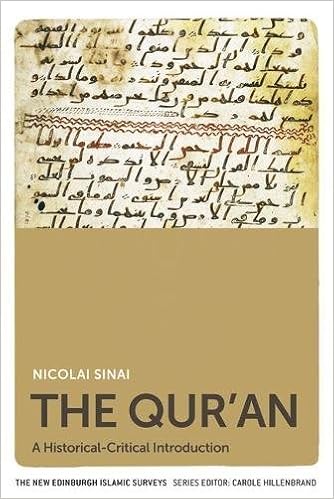
The Qur'an: A Historical-Critical Introduction (The New Edinburgh Islamic Surveys)

Free PDF The Qur'an: A Historical-Critical Introduction (The New Edinburgh Islamic Surveys)
Following the good routine will certainly reveal the excellent practice, as well. When having a great friend that has reading behavior, it is required for you to have that such practice. Well, even reading is actually not your design, why don't you try it when? To attract you to like analysis, we will certainly present The Qur'an: A Historical-Critical Introduction (The New Edinburgh Islamic Surveys) now. Here this book has the tendency to be the most referred publication that many people read it.
To make you little fall in love to review, we will provide the soft file of The Qur'an: A Historical-Critical Introduction (The New Edinburgh Islamic Surveys) to check out. Previously, you need to get it by making handle the web link of the book. This book is type of preferred book checked out by many individuals, from around the world. When you want to do such adventures, but you still do not have sufficient cash, checked out a book and you could feel like remaining in your actual experience.
Don't underestimate; guides that we accumulate them are not just from within this country. You can additionally discover guides from outside of the nation. They are all likewise various with various other. Some web links are given to show you where to locate and get it. This The Qur'an: A Historical-Critical Introduction (The New Edinburgh Islamic Surveys) as one of the examples can be obtained quickly. And why you ought to recommend this publication for yourselves and your good friends is that this publication holds important function to enhance your life quality and also amount.
Make this book as much-loved publication to review currently. There is no better book with the same subject as this one. You could see just how words that are created are really suitable to urge your condition to make far better. Currently, you can additionally feel that the things of The Qur'an: A Historical-Critical Introduction (The New Edinburgh Islamic Surveys) are extended not just for making great possibilities for the visitors yet additionally offer good environment for the outcome of just what to write.
Review
"The best available overview of the subject...Sinai offers not only new insight into the inner structure of the Qur'an, but also a masterclass in textual analysis." -- Eric Ormsby, Times Literary Supplement
Read more
About the Author
Nicolai Sinai is Associate Professor of Islamic Studies at the Oriental Institute, Oxford University, and a Fellow of Pembroke College, Oxford. He has published on the Qur'an, on pre-modern and modern Islamic scriptural exegesis, and on the history of philosophy in the Islamic world.
Read more
Product details
Series: The New Edinburgh Islamic Surveys
Paperback: 224 pages
Publisher: Edinburgh University Press; 1 edition (October 1, 2017)
Language: English
ISBN-10: 074869577X
ISBN-13: 978-0748695775
Product Dimensions:
9.2 x 0.4 x 6.1 inches
Shipping Weight: 14.1 ounces (View shipping rates and policies)
Average Customer Review:
3.6 out of 5 stars
4 customer reviews
Amazon Best Sellers Rank:
#313,717 in Books (See Top 100 in Books)
This is a great book for an unbiased, scholarly investigation into the Quran. Finally we have a resource for studying the Quran from a historical-critical point of view and not from a muslim apologist or anti-muslim crusader. This book is for those seeking detailed, unvarnished textual analysis of the Quran. I hope this will be the beginning of more books from this author and others who want to help get to the bottom of how, when and where the Quran was really written.
This is a disappointing book that could have served as an excellent introduction to the Historical-Critical analysis of the Qur'an. Over the last few years, analysis of the Qur'an has revealed several interesting ideas including those of Gabriel Said Reynolds The Emergence of Islam, Carlos Segovia The Quranic Noah, Stephen Shoemaker Death of a Prophet, Daniel Beck The Evolution of the Early Qur'an, and Fred Donner Muhammad and the Origins of Islam. These texts suggest that the Quran was written and compiled between the 550s and 710s, based heavily on Aramaic and Syriac Christian writings, in a Christian not a pagan location, in Palestine rather than in Mecca and Medina, and by a community that only became Islamic in the 690s. Sinai downplays all these important arguments by any method possibly and so 're-invents the wheel' in arguing for a traditional account without using historical-critical methods.
I think what other reviewers failed to acknowledge is this book is introductory. Sinai's work doesn't cover every single factor it could have, but it covers some of the most important main points: What factors have caused scholars to believe surahs are Medinan versus Meccan? What can reliably be attributed to Muhammad, and what might be later interpolation? What influences were there on Qur'anic interpolation? Without this information, more scholarly works (such as Gabriel Reynolds' "The Qur'an and the Bible") would be overwhelming.If you're looking for a full introduction to Islamic thought, this isn't the book to read. This book is an introduction to Qur'anic critical scholarship. A particular reviewer claims that Sinai gives the impression that the only scholarly opinions that matter are those of white people who speak European languages. This simply isn't true. Sinai outrightly disagrees with many of the scholars he refers to. For example, he explicitly states that he doesn't entirely agree with the chronological scheme of Weil and Noldeke, though he openly admits the merits of their work. He also disagrees with Crone--and others--who disbelieve modern Mecca was the actual site of Muhammad's original revelations. However, he refers to these scholars because he is introducing the reader to historical-critical scholarship. It's obvious he'll refer to European scholars, and do so extensively.As an Islamic studies student, I can vouch for the credibility of this book's contents. This is a must-have introduction. It may not cover all aspects of Qur'anic sciences (I'd recommend Recep Dogan's works on tafsir and fiqh), but it is a great primer. It's a technical read, so you can't expect to sit down and read it through in a day or two (unless you're already well-read in these topics, beyond the need for this type of book).
I expected a more nuanced approach from an established scholar. Instead Sinai gives one the impression that the only studies of the Quran one needs to investigate in order to understand the text are those written by white people in European languages. While many studies continue to be written on the history, language, style and themes of the Quran in Arabic, Persian and other languages. Sinai does not include a single one of these texts in his bibliography, such as Kuttab al-Nabi, "Scribes of the Prophet" by Mustafa al-Azami, which details the role that some companions of the Prophet are said to have had in compiling the Quran during his lifetime. It is also quite remarkable that he leaves out Azami's book on the collection of the Quran in English.Sinai is also not honest about the importance of the historical material regarding the Quran and likens it to the material regarding the collection of the Bible without acknowledging that material regarding the Quran was written within two hundred years of the origin of the text, while that regarding the Old Testament was written over 1000 years of the origin of the text. This makes for some comparisons that are quite misleading for those who do not know the traditions well. The book may still be better than anything else that is out there in book form in the Euro American academy. Nonetheless, it illustrates how far the western study of the origins of Islam has to go if it is to be uprooted from colonialist and collonializing assumptions.
The Qur'an: A Historical-Critical Introduction (The New Edinburgh Islamic Surveys) PDF
The Qur'an: A Historical-Critical Introduction (The New Edinburgh Islamic Surveys) EPub
The Qur'an: A Historical-Critical Introduction (The New Edinburgh Islamic Surveys) Doc
The Qur'an: A Historical-Critical Introduction (The New Edinburgh Islamic Surveys) iBooks
The Qur'an: A Historical-Critical Introduction (The New Edinburgh Islamic Surveys) rtf
The Qur'an: A Historical-Critical Introduction (The New Edinburgh Islamic Surveys) Mobipocket
The Qur'an: A Historical-Critical Introduction (The New Edinburgh Islamic Surveys) Kindle
0 comments:
Post a Comment