


Download PDF The Harvest of Sorrow: Soviet Collectivization and the Terror-Famine, by Robert Conquest
Reviewing publication The Harvest Of Sorrow: Soviet Collectivization And The Terror-Famine, By Robert Conquest, nowadays, will not require you to constantly buy in the establishment off-line. There is a terrific location to buy guide The Harvest Of Sorrow: Soviet Collectivization And The Terror-Famine, By Robert Conquest by on the internet. This website is the very best website with great deals varieties of book collections. As this The Harvest Of Sorrow: Soviet Collectivization And The Terror-Famine, By Robert Conquest will certainly remain in this book, all books that you need will certainly correct below, too. Just hunt for the name or title of the book The Harvest Of Sorrow: Soviet Collectivization And The Terror-Famine, By Robert Conquest You could locate what exactly you are hunting for.
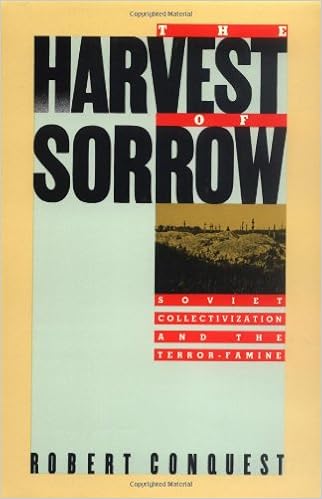
The Harvest of Sorrow: Soviet Collectivization and the Terror-Famine, by Robert Conquest

Download PDF The Harvest of Sorrow: Soviet Collectivization and the Terror-Famine, by Robert Conquest
What's your requirement to be reviewing material in this time? Is that guide that relates to the tasks? Is that guide that can captivate you in your lonesome time? Or, is that just sort of publication that you can check out to come with the downtime? Every person has various reason that they choose the particular publication. It will feature particular cover design, interesting title, advised subject, required motif, and also professional writers.
The presence of this brand-new publication can be a brand-new resource for you. This book is truly appropriate for accompanying your lonesome time in the leisure time. It will certainly be not so enjoyable when having no activities in your spare time. Viewing TV might be bringing. So that means, checking out The Harvest Of Sorrow: Soviet Collectivization And The Terror-Famine, By Robert Conquest could offer you new task and also bring you brand-new lesson. When you really feel so proper with this publication, why do not you take it now?
Checking out a publication can aid you to open the new world. From knowing nothing to recognizing every little thing can be reached when reviewing books sometimes. As lots of people state, more publications you read, extra things you would like to know, but few things you will certainly feel. Yeah, checking out the book will lead your mind to open up minded as well as always try to seek for the other knowledge, even from several sources. The Harvest Of Sorrow: Soviet Collectivization And The Terror-Famine, By Robert Conquest as a method of how guide is suggested will certainly be readily available for you to obtain it.
After establishing the interaction of you in order to like such publication, you could directly find as well as reach download and install and also make manage the The Harvest Of Sorrow: Soviet Collectivization And The Terror-Famine, By Robert Conquest The source can be received from link to offer below. As one of the best publication web site in the world, we constantly supply the best things. Of course, guide that we provide always guide that uses extraordinary thing to learn and obtain. If you think that you truly require this book now, get it as soon as possible.
Review
"A fine, thoroughly documented full-dress historical study of this genocidal campaign. Conquest grabs his reader at the start."--National Review"Vital to understanding 'Stalin's revolution.'"--Patrick J. Rollins, Old Dominion University"The Harvest of Sorrow is not just a heroic work of scholarship, but an embarrassment to Mikhail Gorbachev and an antidote to wishful thinking about the Soviet Union."*"Essential reading for those who wish to understand the nature of the Soviet system...likely to become a classic."--The Wall Street Journal"The Harvest of Sorrow is essential reading for those who wish to understand the nature of the Soviet system, and like Mr. Conquest's earlier account of Stalin's purges of the 1930s, The Great Terror, it is likely to become a classic."--The Wall Street Journal"The most comprehensive history of the Soviet agricultural crisis....Also the most vivid portrayal of one of the great crimes against humanity of the twentieth century."--American Historical Review"The first major scholarly book on the horrors [of Soviet collectivization]....Conquest has succeeded in restoring [the peasants'] human faces."--Time"A very good book of its kind."--T.E. Smuck, University of Hawaii"A superb book on a fascinating topic."--Bruce F. Adams, University of Louisville"A superb book on one of the most important questions in Soviet history."--Herbert Ellison, University of Washington"Excellent....It contains information on the Stalinist era, especially the consequences of collectivization, unavailable in any other book on Soviet society."--L.M. Kowal, University of Michigan"[A] superb work of history."--Newsweek"Meticulously researched...Robert Conquest presents a chilling account of Stalin's regime cold bloodedly killing twenty million of its own subjects."--The Washington Post Book World"Powerful and well-documented."--The New Republic"An excellent book....It is an eye-opener about a period of Soviet history that has been systematically falsified and ignored too often."--Steven M. Miner, Ohio University"A carefully researched and superbly written study. It deals with a period, and a set of problems, that rank among the most important (and most neglected) of Soviet historical studies."--Los Angeles Times Book Review"A comprehensive record of what may stand as the crime of the century."--The Chicago Tribune"Brilliant and brutal. Should be required reading for all of Gorbachev's apologists."--John C.K. Daly, Kansas State University"Absolutely essential to an understanding of the Soviet Union....Meticulously researched and well-written and the only comprehensive study of the appalling tragedy which befell in the Ukraine during collectivization."--Charles W. Chappius, Chicago State University
Read more
From the Back Cover
The first full history of one of the most horrendous human tragedies of the 20th century, The Harvest of Sorrow examines the atrocities inflicted on the Russian peasantry by the Soviet Communist party between 1929 and 1933.
Read more
See all Editorial Reviews
Product details
Paperback: 430 pages
Publisher: Oxford University Press; Reprint edition (November 12, 1987)
Language: English
ISBN-10: 0195051807
ISBN-13: 978-0195051803
Product Dimensions:
8 x 0.8 x 5.3 inches
Shipping Weight: 1.4 pounds (View shipping rates and policies)
Average Customer Review:
4.5 out of 5 stars
70 customer reviews
Amazon Best Sellers Rank:
#375,826 in Books (See Top 100 in Books)
The present day (2015) conflict between Russia and the Ukraine has deep seated roots that have a long history. This book documents the situation in the early 1930s when Stalin attempted to destroy Ukrainian nationalism, coupled with his general policies within the Soviet Union. In addition to deportations of families and executions, he followed agricultural policies that starved a large portion of the population. Millions died, particularly young children and older people. It was always dangerous having a mercurial leader like Stalin who distrusted everyone. People who carried out his policies one year, could themselves fall victim to purges and executions the next year. Reading history can tend to be dry (it is not written as a popular novel), but it is worth sticking to it to understand the background of the present conflict. Putin, like Stalin, seems intent on destroying Ukrainian nationalism for whatever reason.The book provides a good summary of the flawed economic policies of the Soviet Union in the 1930s. Destroying the incentive for people to excel and advance themselves does not work well. That Is coupled with basic problems in Communist theory that fail to put proper values on distribution, and fail to properly match production with market needs.
A must read for anyone wanting to fathom present-day politics in America or anyone interested in understanding the differences between republicanism, socialism, communism and our present-day very loose use of the word 'democracy.' If you want to understand why the WWII generation feared communism, this book will explain it. Don't pick it up for a light read. On the other hand, Conquest researched then documented every concept and description in the book, having attained some from the most difficult sources of the twentieth century, including pre-Paristroika issues of Pravda. Given the density of Conquest's narrative, read the chapter on the children - afterward, you'll want to read the whole book. When you're finished, no one will ever again pull-the-wool over your eyes. If, however, you're predisposed to Progressive policy, this book will offend you.
An amazingly comprehensive collection of detailed information about the terror famine and the collectivisation drive that led up to it, particularly in the Ukraine and the Cossack regions, where a disproportionate number were murdered compared to the rest of the Soviet Union. As in The Great Terror, Conquest is objective in compiling and sourcing data, but does not hold back from reasoned judgments. It's a pity this book has not been more widely read. During the Cold War, Conquest was often dismissed as a Cold Warrior or anti-communist, and perhaps just as often used by right-wing extremists (and even anti-semites, who will actually find no justification whatever for their views in this book) to bolster their own agendas. Now that the books have been thrown open in Russia and the Ukraine, this book appears almost as an understatement of the horrors of the first half of the 1930s.
Since WWII Jews around the world have routinely resolved to “never forget†Hitler’s brutal effort to destroy the Jewish people. So too all of us should determine to never forget the far costlier devastation visited upon Russia by Joseph Stalin. In concentration camps such as Belsen and Auschwitz the Nazis slaughtered some six million people, but a decade earlier, in the Ukraine and adjacent Cossack areas in southern Russia, the Bolsheviks killed nearly twice as many peasants—totaling more than all deaths in WWI. The late English historian Robert Conquest devoted much of his life to finding, rigorously documenting, and publishing the truth regarding what transpired in the Soviet Union between WWI and WWII. One of his most powerful treatises is Harvest of Sorrow: Soviet Collectivization and the Terror-Famine (New York: Oxford University Press, c. 1986). The book’s title is taken from “The Armament of Igor,†a poem lamenting that: “The black earth / Was sown with bones / And watered with blood / For a harvest of sorrow / On the land of Rus.’†For many centuries Russian peasants were serfs—working the land of aristocratic landowners who often exploited them. Reform movements in the 19th century, much like anti-slave movements in America, led to their liberation in the 1860s. While certainly harsh by modern standards, their lot slowly improved, though like sharecroppers following the Civil War in America they were generally landless and impoverished in a nation firmly controlled by the Tsar and aristocracy. Thus the Bolshevik revolution in 1917 was initially welcomed by peasants who often seized and carved up the large estates they worked on, hoping for the better life promised by the upheaval. Yet they “‘turned a completely deaf ear to ideas of Socialism’†(p. 44). As Boris Pasternak made clear, in a passage in Doctor Zhivago: “‘The peasant knows very well what he wants, better than you or I do . . . . When the revolution came and woke him up, he decided that this was the fulfillment of his dreams, his ancient dream of living anarchically on his own land by the work of his hands, in complete independence and without owing anything to anyone. Instead of that, he found the had only exchanged the old oppression of the Czarist state for the new, much harsher yoke of the revolutionary super-state’†(p. 52). Realizing that the innate love of farmers for land ownership and free markets militated against his totalizing ideology, Lenin noted that he would ultimately “‘have to engage in the most decisive, ruthless struggle against them’†(p. 45). He’d found that Communists such as himself knew little about economics—as was evident when he tried to abolish money and banking—and quickly launched the New Economic Policy, effectively restoring important aspects of capitalism. He also had to find effective ways to encourage agricultural productivity, so he delayed collectivizing agriculture in the 1920s. By the end of that decade, however, Joseph Stalin had seized sufficient power to undertake the radical restructuring of Russian agriculture. A 1928 grain crisis prompted Party bureaucrats to mandate production quotas, taxes and distribution mechanisms. They also needed scapegoats to blame and signaled out the best, hardest working and most prosperous farmers (the kulaks who owned a few acres and a handful of animals and even hired laborers as needed) who seemed to qualify as closet capitalists and “wreckers.†As Stalin declared: “‘We have gone over from a policy of limiting the exploiting tendencies of the kulak to a policy of liquidating the kulak as a class’†(p. 115). Stalin and the Soviet Politburo established the All Union People’s Commissariat of Agriculture, staffed by alleged “experts,†which was authorized to push the peasants into collectives and set utterly utopian, ludicrous goals for yearly harvests. Such policies (part of Stalin’s Five Year Plan) led to an “epoch of dekulakization, of collectivization, and of the terror-famine; of war against the Soviet peasantry, and later against the Ukrainian nation. It may be seen as none of the most significant, as well as one of the most dreadful, periods of modern times†(p. 116). Farmers who failed to meet their quotas or “hoarded†grain (even seed grain!) were arrested and resettled in remote regions if not shot or sent to camps. Conquest documented, in mind-numbing, heart-rending detail, this deliberate destruction of those who stood in the way of Stalin’s grand socialistic agenda. To the Party, in the words of a novelist, “‘Not one of them was guilty of anything; but they belonged to a class that was guilty of everything’†(p. 143). And in the “class struggle†intrinsic to Marxist analysis, evil classes must be destroyed. Sifting through all the documents available to him, Conquest estimates that at least fourteen million peasants perished. “Comparable to the deaths in the major wars of our time,†Stalin’s “harvest of sorrow†may rightly be called genocide. Above all, Stalin targeted the peasants of the Ukraine, the Don and Kuban, where a massive famine transpired in the early ‘30s. Party activists (generally dispatched from the cities and lacking any knowledge of agriculture) presided over the process. One of them recalled: “‘With the rest of my generation I firmly believed that the ends justified the means. Our great goal was the universal triumph of Communism, and for the sake of that goal everything was permissible—to lie, to steal, to destroy hundreds of thousands and even millions of people, all those who were hindering our work or could hinder it, everyone who stood in the way’†(p. 233). One of the few Western journalists daring to discern and tell the truth, Malcolm Muggeridge, said: “‘I saw something of the battle that is going on between the government and the peasants. The battlefield is as desolate as nay war and stretches wider; stretches over a large part of Russia. One the one side, millions of starving peasants, their bodies often swollen from lack of food; on the other, soldier members of the GPU carrying out the instruction of the dictatorship of the proletariat. They have gone over the country like a swarm of locusts and taken away everything edible; they had shot or exiled thousands of peasants, sometimes whole villages; they had reduced some of the most fertile land in the world to a melancholy desert’†(p. 260). Consequently, Soviet agriculture imploded. In 1954 the Nikita Khrushchev admitted that despite the more highly-mechanized farming techniques in the collectives “Soviet agriculture was producing less grain per capita and few cattle absolutely than had been achieved by the muzhik with his wooden plough under Tsarism forty years earlier†(p. 187). And what’s true for agriculture is true for the rest of the USSR under Communist rule—socialism inevitably destroys whatever it controls.
Conquest takes the reader into a dark, deep journey inside the Stalinist state. He illustrates the destruction of a society which produced in abundance and to excess prior to the socialist boot put on the throat of the hard working, patriotic peasant by the tyrannical leaders of the socailist paradise. Conquest is explicit. The reader feels compassion and great sorrow for the incalcuable suffering of the Soviet Union's most vulnerable men, women and chlldren. It is not possible to read this account of unchecked, central government brutality and not appreciate the horror of what happens to societies in which the ruling elite have no reason to fear the ruled.
The Harvest of Sorrow: Soviet Collectivization and the Terror-Famine, by Robert Conquest PDF
The Harvest of Sorrow: Soviet Collectivization and the Terror-Famine, by Robert Conquest EPub
The Harvest of Sorrow: Soviet Collectivization and the Terror-Famine, by Robert Conquest Doc
The Harvest of Sorrow: Soviet Collectivization and the Terror-Famine, by Robert Conquest iBooks
The Harvest of Sorrow: Soviet Collectivization and the Terror-Famine, by Robert Conquest rtf
The Harvest of Sorrow: Soviet Collectivization and the Terror-Famine, by Robert Conquest Mobipocket
The Harvest of Sorrow: Soviet Collectivization and the Terror-Famine, by Robert Conquest Kindle
0 comments:
Post a Comment